Saturday, July 5, 2014

The magic of Mungo

One of the main draw cards of holding the Australasian Quaternary Association conference in Mildura was the chance to visit the Willandra Lakes and in particular the World Heritage Area of Lake Mungo. The trip was very special as we were accompanied by several elders representing the traditional owners of the land and the scientists that have been uncovering the discoveries of the area and as a result we were allowed to go to areas that are out of bounds for the tourists. As a result we ended up with over 100 people and a large convoy of vehicles.
The convoy

We started with a special smoking ceremony at the visitor centre and meeting place. We then headed to Joulni – the area where the burials of Mungo man and woman were uncovered by the erosion of the sand dunes by wind and rain. These were found by Jim Bowler and have been dated to around 40,000 years. We then headed to an ongoing archaeological  excavation by Nikki Stern’s group. They are very carefully excavating some hearths to see what the aboriginals were eating – a mixture of fish and small vertebrates. The sedimentological context of all these archaeological sites have also been studied to provide the age and the environmental conditions. We also visited the footprints that were discovered in 2005.
The smoking ceremony

Joulni - the location of the first stake is where Mungo Man was uncovered
The ongoing archaeological dig, excavating some hearths to find out what aboriginals ate 20,000 years ago

The site of the footprints from 20,000 years ago, now covered to protect it from erosion

I visited Mungo about 10 years ago, and it was very different this time as it was a lot more lush and green - although the lakes are still dry! It was great to see all the new work going on in the area, expanding the original story and making more sense of the aboriginal occupation of the area when the lakes were full or fluctuating.


It is quite a beautiful and fascinating place - I highly recommend a visit. It is clearly a very special place for Australians and I am sure it will increase in its importance with the new archaeological finds and paleo-climatological studies. 
Some of the residuals of the lunette over looking "lake" Mungo

Thursday, July 3, 2014

Quaternary conference in Mildura, Australia

I arrived in Melbourne very early in the morning. Unfortunately I hadn’t slept very much on the flight. A few of us were picked up by one of the buses and were driven up to Mildura with a few stops along the way to look at historical and geological features... we were roughly following the Burke and Wills route. After a lot of flat, straight roads, past lots of fields and eucalypts, and salty lakes we arrived in the heaving metropolis of Mildura.... 
The Burke and Wills Route

Dead trees due to the high salinity of the lakes

The Sealake salt company - harvesting salt and gypsum from the lakes

Mildura is the result of large scale irrigation scheme set up by the Chaffey Brothers siphoning water from the river Murray. This allows fruit to be grown, specifically oranges and grapes - the latter to make sultanas, raisins and currants out of. I went for a wander along the river and around town before the conference started.
The river Murray

Rio Vista - the Chaffey house, now the art gallery

The next few days we had a whole range of talks covering topics of archaeology, dunes, lakes, changing climate, management, Antarctica, and much more. 

The conference dinner was held on a paddle boat on the Murray River that runs past Mildura. 
One of the many paddle boats on the Murray River

Half way through the week we went on a little field trip in the afternoon to Kings Billabong and Psyche Bend – named after a paddle steamer, but why was the paddle steamer named Psyche? This was a billabong that they pumped river water into using a large steam engine, to store it for irrigation. However, it has created a super saline and acidic wet land (pH of 3).

Kings Billabong - one of the many wetlands along the Murray River

Psyche Bend - with lots of dead trees killed by the corrosive and saline waters

The old pumps that used to pump water from the Murray River into Psyche Bend lagoon

Monday, June 23, 2014

Short stopover in Barcelona

Barcelonetta (down by the sea) was heaving with tourists and locals as it was the first few days of the school holidays. I took a stroll along the beach, people watched and paddled in the sea. Then enjoyed a Sangria and Tapas. In the morning I headed over to the marine institute to catch up with a student that is hoping to work on some of the marine cores from New Zealand. She showed me around the labs and we had a good chat about some options. 
The Barcelonetta esplanade

One of the random sculptures on the beach

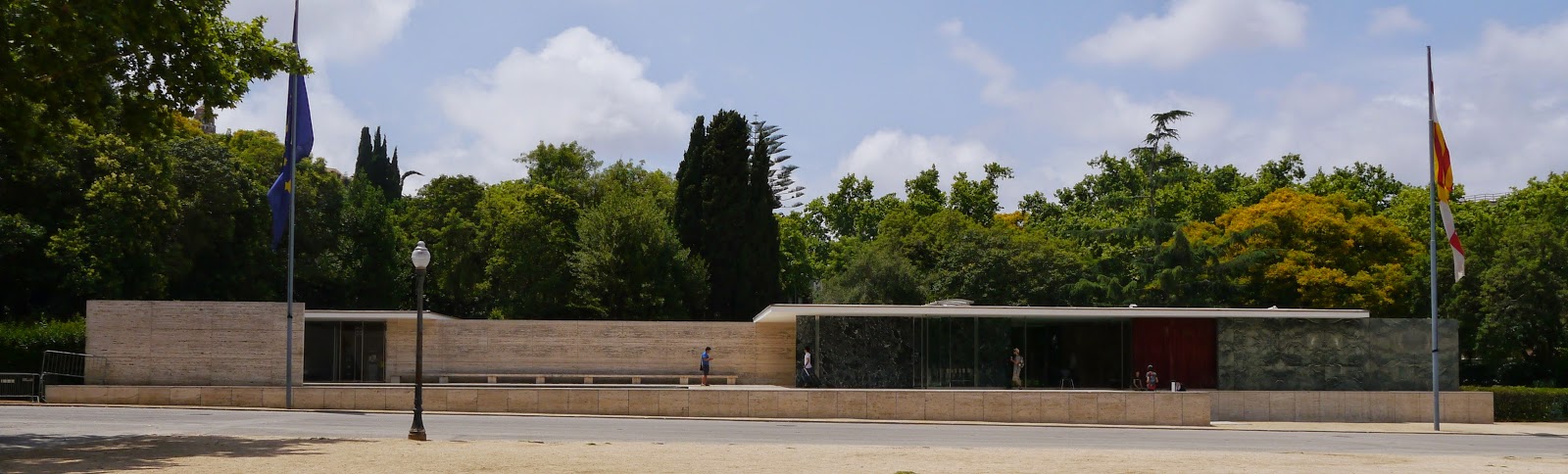
Then in the afternoon I headed over to the Plaza del Espana to visit the famous Barcelona Pavilion designed by Mies van der Rohes. This is one of the buildings that Aaron has had to draw for his new architecture technical course, so I took lots of photos for him. I then walked to Plaza de Catalunya and down Las Ramblas to the beach. A short visit to Barcelona and a shame I couldn’t stay a day longer as that evening is their big fireworks on the beach.... 
The Barcelona Pavilion by Mies van der Rohes

Looking across the pond 

Inside the pavilion - with some of Mies van der Rohes furniture

The other reflective pool

Looking either side of the back wall

Sunday, June 22, 2014

The city of Zaragoza, Spain

The hotel where the workshop was held was on the outskirts of Zaragoza, so we didn’t see much of the city. Despite the ultra modern surroundings of the hotel, Zaragoza is a very old town with a lot of history. On Friday night after a day in the field our wonderful Spanish hosts decided it was time to see a bit of the city and taste some traditional tapas. They also showed us a few sights of the old town including the main Plaza de Pilar and the remains of the Roman amphitheatre. 
One of the old traditional tapas bars

The remnants of the Roman Amphitheatre

However, after the meeting I stayed an extra day in Zaragoza to explore some more. So after finding a central hotel in Plaza d’Espania, I headed to the Basilica de Pilar. It was great to escape the heat of the day. Then when it cooled down a little more after 5:30pm I walked around the town and went to the Pablo Gargallo art gallery and checked out some of the Moorish influenced architecture. A little later there was a music festival with lots of different stages in the different plazas with local musicians and dancers of different flavours. A fun evening wandering between different plazas checking it all out.
The castle

Lots of Moorish influenced buildings

The basilica from the river side


Sunday morning before it got too hot I did a little more exploring around the city before taking the fast train (>250 km/hr) to Barcelona. (There should be more fast trains in the world - great way to travel). 

Saturday, June 21, 2014

Field trips in Aragon, Spain

As with many geology workshops there is usually a field trip to the surrounding area. This sounds like a good jolly – but actually I think it is where a lot of the networking goes on while sitting on the bus and also for me I learn more in the field than sitting listening to people talk in a lecture room.
The first day we set off very early and drove up to the Pyrenees to see the glacial morphology. We had perfect weather and the views were spectacular. It would have been great to do some hiking – hopefully next time! We also saw a series of moraines further down the valleys showing the extent of the glaciers during previous glacials. The big mystery is that there is no evidence of the last glacial....? Was it too dry?
Spectacular views of large U-shaped valleys in Ordesa National Park

An explanation of the geology and geomorphology

The second day we headed in to the Iberian Range, to karst country. We spent the day around the Monastery of Piedra, now a hotel, but previously owned by a wealthy family. This region is surrounded by limestone and the river waters are so concentrated with carbonate that they are precipitating limestone as they go over water falls (like stalagmites and stalagtites in caves). These tufa deposits are growing rapidly at almost 10 cm per year... so the waterfalls are actively managed in the park to make sure they don’t grow too big... or start to cause flooding.... It was very cool and lush in the park, an oasis compared to the surrounding dry and hot karst plateau.
One of the many water falls in the Monastery de Piedra park

The largest waterfall which you walk down behind

The fish ponds in the limestone gorge

On the final day we went west into the “Badlands”. I will have to look up the origin of this name – but it is basically very soft sediment that is eroding rapidly. There is a cap of hard mudstone on the top of the sediments which has protected some of the sediment below to form mesas and pillars. But we were here to look at the fluvial erosion and deposition during the Holocene (the last 12,000 yrs). It is amazing that people live here and grow crops as it is a highly changeable landscape. Of course it is usually very dry... but there was rain the night before so there was a very muddy river flowing and we couldn’t get up close to the sections we had hoped to get to see.
One of the almost eroded mesas...

Eroding Holocene fluvial muds... 


Three different landscapes and geological/geomorphological processes. Some associated with cold periods and others with warm and others probably a combination of both – as unfortunately the dating is not well constrained. A few weird features that are also still hard to explain and more work to do. It is clear that Spain has a diverse landscape. I look forward to coming back and exploring some more. 

Wednesday, June 18, 2014

Workshop in Zaragoza, Spain

I flew in to Zaragoza and met various people going to the same workshop as me on the plane - the poster tubes and the technical conversations gave them away... The meeting was being held in a hotel built on the N side of the river Ebro. It was a bit of a strange place surrounded by lots of other new buildings and space age bridges that were built for the 2008 world expo, but due to the economic crisis now sit empty. So it felt like we were in a bit of a ghost town as we were just out of the city itself. 
 The entrance to the Hotel Hiberus

The strange cable car that never runs and various buildings on the north side of the Ebro River

The pedestrian bridge/spaceship/art gallery

The main traffic bridge

We had 3 days of talks. It was good to hear what our European counterparts have been doing and I got some good feedback on what we aim to do in our equivalent project in the Southern Hemisphere. I met lots of people and hope to have developed some new collaborations.. 

After a couple of days trapped inside we were taken on 3 days of field trips to a range of different places around the city....more in following blogs. 

Sunday, June 15, 2014

Quick visit to UK

A few months ago I was invited to a workshop in Spain and managed to get some funding for the flights from the New Zealand Royal Society. After a long, long, long flight via Auckland, Brisbane, Dubai – I arrived in London and caught the bus to Coventry where I was met by Grandma and Grandad. Mum and Dad arrived the next day from Aberdeen and it was great to catch up with everyone, including Aunty Irene and Uncle Jim. Then Mum and Dad and I headed down to Paul and Thalia’s to see their new house and catch up with the kids. The house is almost finished... just a few minor things to be fixed and grass to grow. It looks great and it will be amazing when it is completely finished. I was especially jealous of the enormous larder and the kids playroom with it’s lego floor! Needless to say we played quite a bit of lego – especially as Hattie got some for her birthday. We also played a lot in the garden and went for a couple of nice walks with lunch at RAF Halton – an ex-Rothschild House.
Paul and Thalia's new house


It was nice to spend a few days seeing family and getting over jetlag – greatly helped by the fact that it stays light until 10pm. Thanks for the hospitality – I hope to return it one day when you come and visit us in New Zealand.