Monday, September 24, 2012

Spring!

Wonderful weather this weekend, so lots of action around the house and garden. Weeding, mowing, chopping back trees, turning the compost, cleaning the windows.....I suppose you call it spring cleaning.
The flowers and veggie seedlings are out, and the cats were enjoying the sunshine.... although they had to move occasionally when it got too hot! A very satisfying weekend.

 Mifi getting some sun on her belly - so lady like!

Safi under one of the chairs - half in the sun, half out...

 We removed a semi-dead tree and had to put up a trellis so that all the people on the steps can't see in the house. Aaron is weaving flax leaves through the trellis to create more of a screen.

Tomato and courgette/zucchini seedlings coming through

Monday, September 17, 2012

Birthday toys

Helen bought me a table saw for my birthday on the weekend. I have been  in need of one for a while to complete several projects I have going. I am not allowed to start any new projects until I finish the ones I have going now. I have lots of ideas for new projects, so I need to get things finished up.

Both of my step projects required the table saw. For the fronts the second board is not a full width so it needed to be cut along its long axis. I could have done it with the jig saw but the table saw made it much easier, safer and straighter.


The steps at the back
I am not quite halfway done with the steps up the back. I have been using wood left over from the new deck, but I am nearly out. I still have plenty of kwila left over from the old deck to finish off the steps on the side. I have fronts on three of them now with five more to go.


The side steps
The steps out the back had several ferns growing out from underneath them which I transplanted to the north slope. They are kind of hard to see amongst all the weeds. Keeping this bank under control is a never ending battle. Each year we seem to get a little further ahead. Maybe some day we will have it under control. One of my future projects may help...

Relocated ferns (slightly right of centre)

Saturday, September 15, 2012

Wining and Dining in the Wairarapa

Last weekend was our 7th Wedding Anniversary. Can you believe it? We can't. Aaron took me away for a relaxing weekend over in the Wairarapa. The weather forecast was aweful - and a few hours after we got over to the Wairarapa they had closed the road over the Rimutakas due to the 140 km/h winds. Fortunately this didn't interfere with our plans to go wine tasting around Martinborough. In fact it was nice and quiet as there were very few Wellingtonians there.

We went to 3 wineries. We like to go to the small ones that don't sell at the supermarkets, and where the person doing the wine tasting/selling is usually the wine maker. This time we went to Hawthornwaite where Mark, the South African wine maker, spent a good hour telling us all kinds of stories, about the wine, about how he came to have a winery, etc.. We were about half way through tasting the wines when his wife came out and the stories all stopped.... and we were then rushed through the last few wines.

The second winery we went to was Muirlea, where the wine maker is a real character and was getting us to try his experiments with mixing Pinot and Syrah... interesting how the Syrah overwhelms it even when there was much less of it. Finally we went to an old favourite, the Cabbage Tree vineyard, where they make the only chardonnay in New Zealand that I like and where the woman was very chatty and we chatted about life the universe and everything - especially the terrible job the current government are doing...

After a nice dinner and a wild blowy night, we went to the local daffodil fair in Carterton and had a quick look around and helped the local economy... before heading back to Wellington. A very pleasant weekend.

Thursday, August 23, 2012

Shark fishing and snorkelling

Back on the ship the expeditioners got to go snorkelling with the Experiencing Marine Reserves (EMR) crew, and most of us saw sharks and lots of fish. Some lucky ones even saw turtles. We had a professional underwater photographer with us, Steve Hathaway, so I didn't bother to take any photos - here is a link to the video on youtube. http://www.youtube.com/watch?v=PFCp3cI7fGg&feature=youtu.be

Rochelle and I ready to go snorkelling


Clinton Duffy also spent most evenings fishing for sharks of the stern ramp. He was taking DNA samples from the sharks (a little clip off one of their fins) to determine how related these Galapagos sharks are to others around the South Pacific. Many of the crew and students helped out with the fishing, while Clinton just wrestled the sharks as they were brought on board. The first night they weren't biting when squid was put out in the berley bag, but then they switched it to pilchards and it worked a treat. They managed to catch 17 galapagos sharks and 5 smooth hound sharks that are unknown, so Clinton kept a sample to take back to the Auckland Museum to describe and name it.

 Clinton getting the fishing rods ready

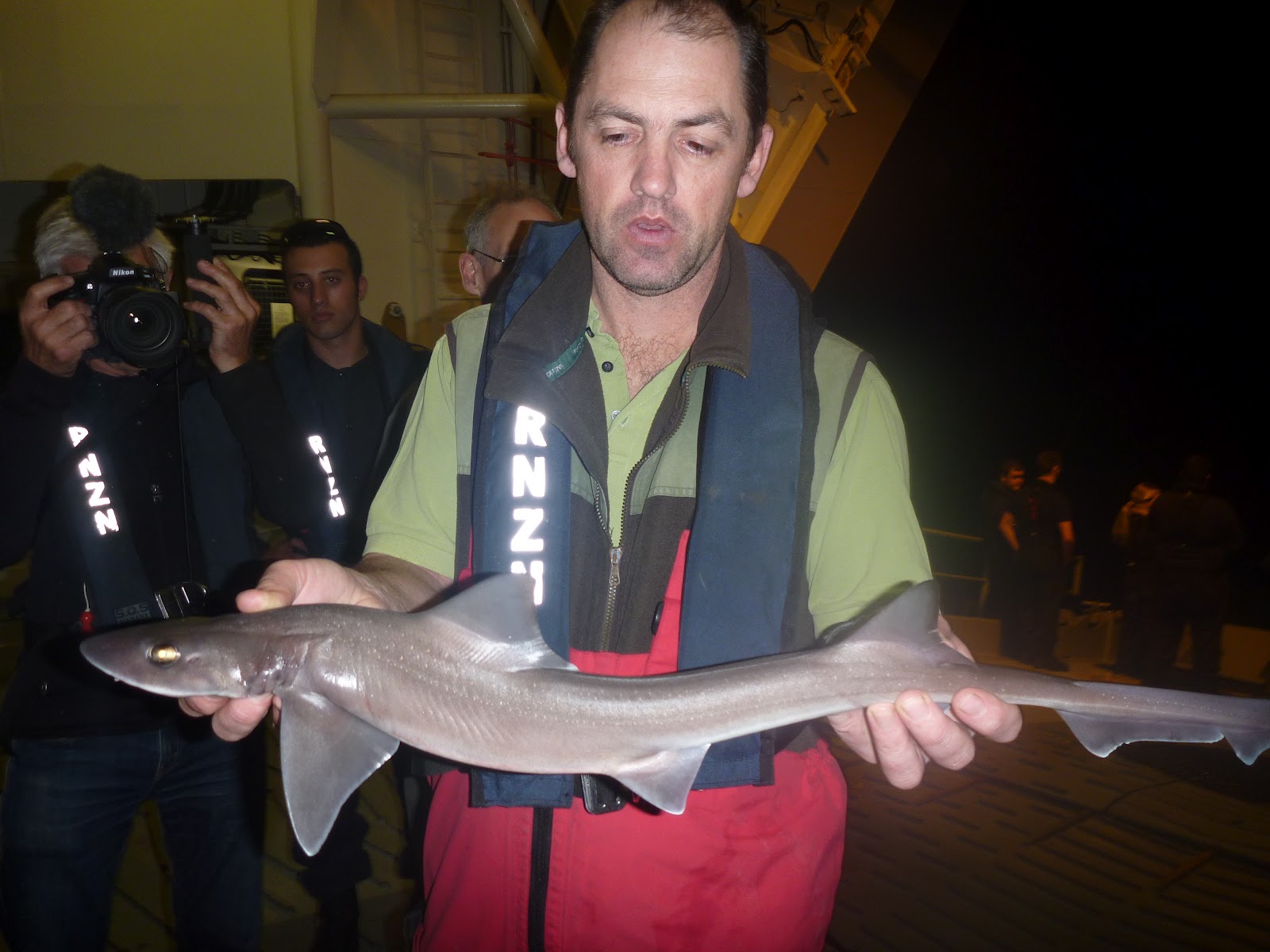
 The undescribed species of smooth hound shark

Clinton and co. wrestling one of the larger galapagos sharks to take the measurements, DNA sample and attach a tag

Unfortunately, despite a lot of patience and a couple of chases on the RHIB, Rochelle Constantine only got a couple of photos of dolphin fins and one biopsy sample from a whale for her research on cetaceans from this region. It was a lot easier to collect plankton samples and I used my net on 3 nights and got a whole range of beasties that we looked at down the microscope I had brought along with me. As far as we know this is the first time that anyone has sampled for plankton in this area, so hopefully there is something of interest for the experts.

After 10 days it was time to sail back to New Zealand, a relatively uneventful and smooth trip back, with time to discuss many things that had happened and for the kids to discuss the problems of the world and how they were going to solve them (I'm sure I was that naive too at that age). Although there was one last bit of excitement as the Navy had to rescue some guys whose boat was sinking just off the Coromandel Peninsular. They had just been practising their helicopter winching the day before, so they were ready to go. It took them 38 minutes. Go the Navy!

Raoul Island - part II

Day two on the island, the rain had stopped, so we headed up and over the hill to the other side of the island, to Denham Bay. This was rather a steep walk with a couple of ropes to aid you down/up the Denham Bay side. It was great to get some decent exercise stretch our legs and explore the island a bit, especially the beautiful Nikau forest. I was keen to look down into the crater that erupted in 2006. You can still see the devastation of the eruption.

 Walking on the ridge through the Nikau forest

Looking down on to the 2 lakes: blue lake (left) and green lake (right) with the dead trees around the lake from the eruption

On the beach in Denham Bay there is the remnants of a Japanese fishing boat that grounded itself, some pumice from the pumice raft, and sadly quite a bit of rubbish on the beach. It seems our plastic rubbish can get to every remote region of the world.

 Looking down on Denham Bay

 Climbing down into Denham Bay

The japanese fishing trawler and lots of pumice on the beach

Raoul Island - part I

After two days of steaming and a lot of pumice,we finally arrived at Raoul Island. Unfortunately Raoul is rocky and difficult to land on unless it is really calm. So the first half of expeditioners got on to the island via the RHIB (Rigid Hull Inflatable Boat) and Zodiac on to the rather sketchy Fishing Rock landing. However, the weather packed in, so when it came to the second half of the team to swap over, the transfers had to be done with the Seasprite Helicopter. Fortunately the helicopter had finished hauling gear back and forward for the Department of Conservation (DOC), so it was available to shuttle us on and off the island. So I got to go in a helicopter for the first time in my life. Not sure I would rush to do it again as the sudden jolting and changes in direction didn't sit very well with my stomach. So while I don't get sea sick, I am definitely prone to air sickness - possibly due to the more random nature of the movements.

Dressed in my helmet and life jacket for the helicopter flight

The seasprite having dropped us off on Raoul Island

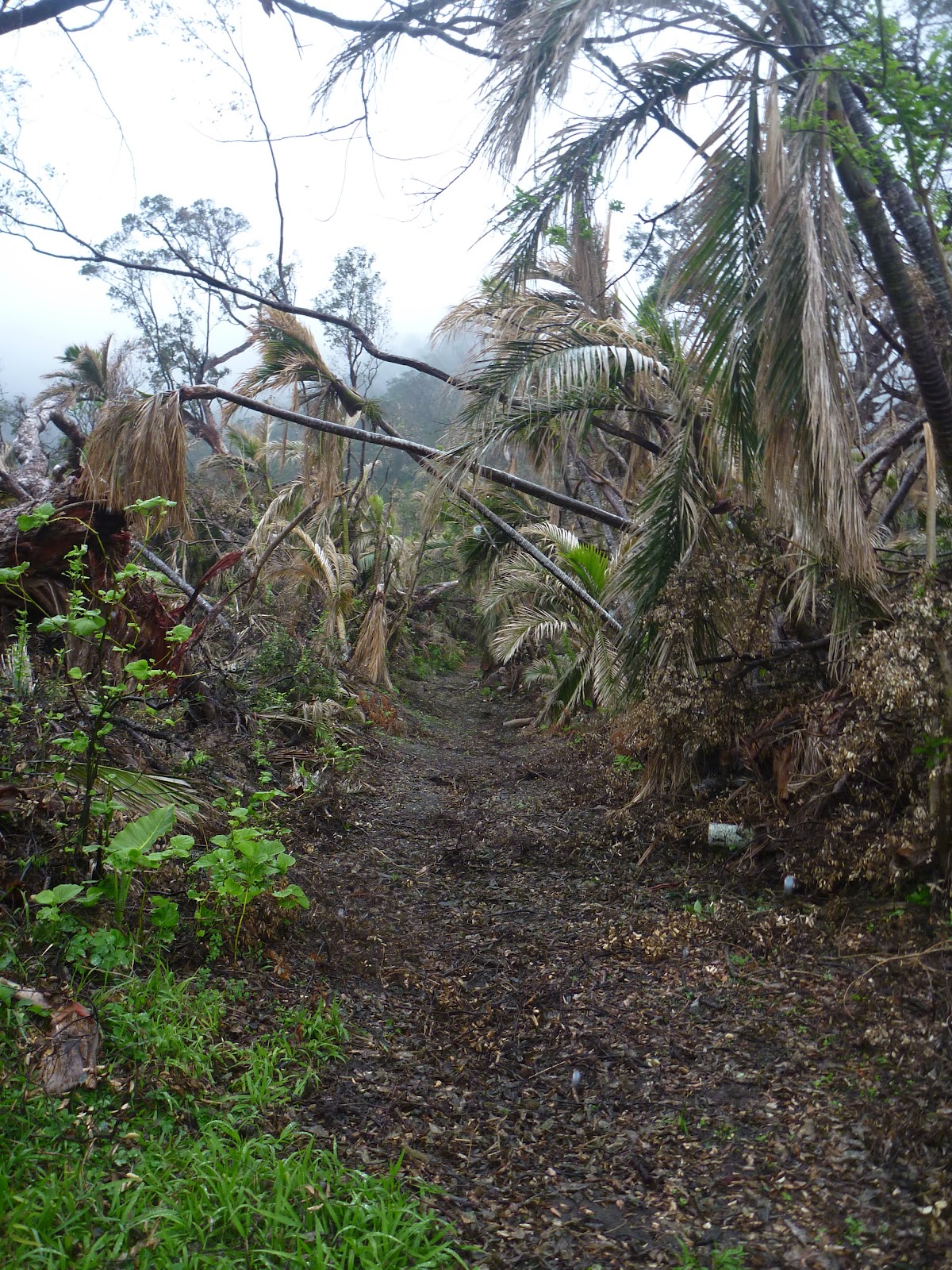
Life on the island was very different. DOC is a very different beast to the Navy. The island had been hit by a cyclone just 5 weeks earlier and some areas were devastated, including several of the buildings that were being fixed. There was also the annual changeover and lots of annual checks on instruments etc.. However, it seemed a lot more relaxed. We were camping on the lawn in front of the Hostel, with the Pukeko, friendly Tuis and Kakariki. Now I can understand how the Tuis and Kakariki got to the island from mainland New Zealand as they can fly pretty well... although we are told these are different subspecies so must have been here a while, however the pukeko are rather pathetic flyers - so their presence didn't make much sense unless they were brought there by maori (or they could have floated on pumice rafts!)

 Nikau palms knocked over and killed by the cyclone

The roof of the shed had been blown off and was a few hundred metres away in the trees...

Our first day on the island it was pouring with rain and we looked around and chatted to the DOC guys on the large verandah at the hostel. The DOC team spend most of their time weeding on the island trying to get rid of the plants that europeans brought with them, including peach, passion fruit, guava etc.. However, there are several orange and other citrus fruit trees and fig, that are allowed to stay and not be removed as they are now deemed historical (I assume as long as they don't spread). They also have several veggie patches so that they get fresh greens throughout the year and to supplement the food that is airlifted in once a year.

 One of the veggie patches

The hostel and tents on the lawn

In the evening we were given army RATion packs to eat. See below for what they contained. I barely managed it through the noodles and the main meal. One of the students took it upon himself to try and eat the whole lot - it does say that you should consume the whole thing in 24 hours -but I assume that is only if you are in a intense combat situation when you are burning lots of calories. I think he had a rather bad belly ache after he tried.
The contents of the RATion pack - it is canned cheese!

The hostel lit up at night by the newly installed solar panels and batteries

Pumice

I had just given a lecture to the expeditioners about the geological evolution and formation of the Kermadec region and why the volcanic Raoul Island exists - when there was a commotion on the bridge and we were changing course to go and check an expanse of white/cream on the ocean surface, up to 250 km long and 100 km wide, that had been spotted by a maritime surveillance plane flying back from Tonga. The Captain Sean Stewart called me over to ask me what I thought it might be? "Well it is unlikely to be an ice-berg this far north - most likely it is pumice from a volcanic eruption." He was a little reticent about approaching it as it might do damage to the ship, but we set off to see if we could intercept it.

A few hours later we started to spot the first few pieces of pumice floating by (we were actually trying to spot whales and dolphins at the time as we were still quite a way from the original sighting by the aircraft). The concentration of pumice started to increase over the next few hours and we used some high tech ropes and buckets to try to catch pieces as they floated by. The pumice pieces ranged in size from marbles to soccer balls. Unfortunately the wake pushed the pieces out from the side of the ship, making it rather hard to catch them. It became quite competitive between the guys with the buckets.... after about 30 minutes we had collected just 30 pieces of pumice and the largest one the size of a tennis ball.

The captain and the buffer with the largest piece of pumice

We continued to see pumice streaks for the rest of the afternoon, but assumed that the wind and waves had dispersed the original expanse seen on the photos. However at midnight the ship hit a large concentration of pumice, 1 m deep and stretching as far as the spotlights could see, although only 600 m wide. Unfortunately they didn't take any photos or collect any samples, or wake me up, but they did take down the position. Th officer of the watch Lt Tim Oscar described it as "the weirdest thing I have seen in the 18 years I have spent at sea." However, I did get some samples as it turns out that some pumice got sucked up into the water intake system that cools the engine and they were cleaning out their filters the next day and gave me some of it.

Science writer Rebecca Priestley was writing a daily blog for the expedition and as an ex-geologist she decided to cover the pumice story. The navy also decided to put some photos up on their website and reposted her blog - for some reason the media jumped on the story and it was reported all over the world. It must have been a slow news day! Several other organisations jumped on the band wagon with their own interpretation and information. The satellite images from NASA show that the pumice was first seen on the 19th July and that its most likely source is Harve volcano. We originally thought it might be Monowai as we  knew there was ongoing seismic activity there, but it was a lot further north. I have given the pumice samples to a student at Victoria University in Wellington that is studying this region and working on pumice to analyse. The chemical fingerprint of the pumice will help us to determine which volcano they are from. Hopefully we will know in a couple of weeks - watch this space.

The streaks of pumice intercepted again on the way back from Raoul

So I became a vulcanologist for the trip - there was supposed to be a vulcanologist from GNS Science on the voyage up to Raoul, but he had pulled out at the last minute due to the eruption of Tongariro in the north island the day before we left. You just can't escape geology in New Zealand.